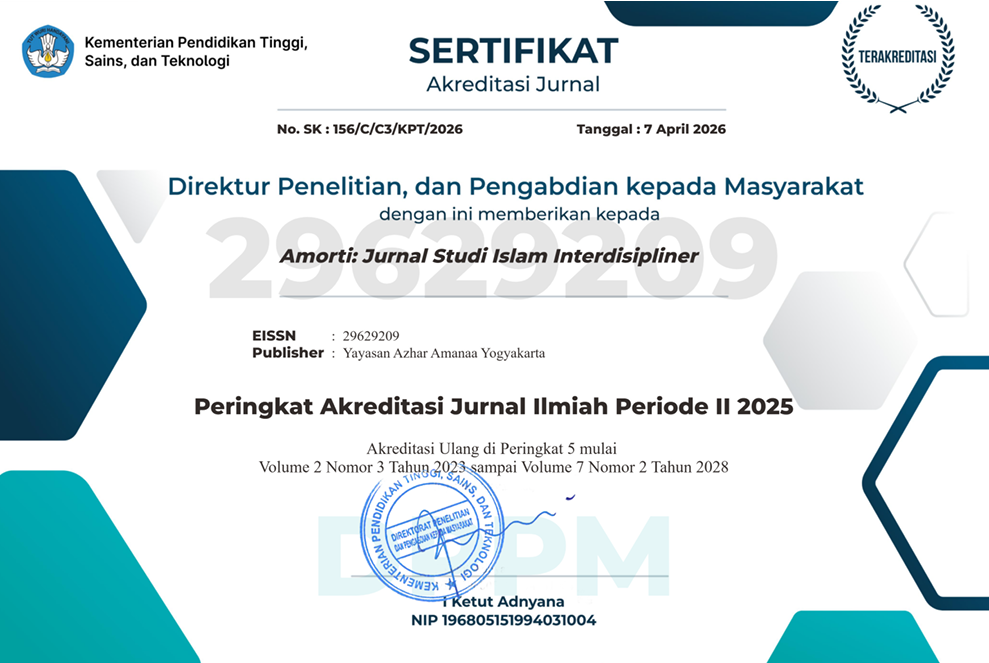
Al-Quran Memorization Learning Using the Edutainment Method at Al-Kiswah IT Kindergarten, Bengkulu City
DOI:
https://doi.org/10.59944/amorti.v4i3.1084Keywords:
Al-Qur'an memorization, edutainment method, early childhood education, Islamic educationAbstract
This study aims to analyze the implementation of the edutainment method in Al-Qur'an memorization learning at Al-Kiswah IT Kindergarten, Bengkulu City, and to examine its contribution to improving children's memorization abilities and learning experiences. The study employed a qualitative case study approach to obtain an in-depth understanding of learning practices within a natural educational setting. Data were collected through classroom observations, in-depth interviews with school principals, teachers, and parents, as well as document analysis related to learning plans and students' memorization progress. The data were analyzed using the interactive model of Miles, Huberman, and Saldaña, including data condensation, data display, and conclusion drawing. The findings indicate that the edutainment method creates an engaging, interactive, and child-centered learning environment by integrating educational games, storytelling, songs, rhythmic repetition, movement, audiovisual media, and collaborative learning activities into the memorization process. These instructional strategies enhance children's motivation, concentration, self-confidence, and active participation while facilitating better memorization and long-term retention of Qur'anic verses. Furthermore, the method contributes to the development of positive character traits, including discipline, cooperation, responsibility, and a stronger emotional attachment to the Qur'an. The study concludes that the edutainment method is an effective pedagogical approach for supporting Al-Qur'an memorization among early childhood learners because it accommodates children's developmental characteristics while promoting meaningful and enjoyable learning experiences. The findings provide practical implications for teachers, parents, and Islamic educational institutions in developing innovative and child-friendly Qur'anic memorization programs.
References
Aida Hidayah. (2017). Metode Tahfidz Al-Qur'an untuk Anak Usia Dini. Jurnal Studi Ilmu-ilmu Al-Qur'an dan Hadis.
Arief Faqihuddin. (2024). Multisensory approach in memorizing the Al-Quran for early childhood: Integrating technology and active learning. Al-Ishlah: Jurnal Pendidikan.
F. Hidayat. (2017). A psychological study of Quran memorization for early childhood children. In Proceedings of the 2nd Annual Conference on Islamic Early Childhood Education (pp. 89–94).
Dwi Yulianti., & Muhammad Slamet. (2019). The effect of memorizing Quran on the children's cognitive intelligence. Humanities & Social Sciences Reviews, 7(3), 571–575.
Dian Novita Rusdiah. (2021). Implementation of Al-Qur'an memorization for early childhood: Case study of parents who have status as members of the Tabligh Jamaah in Banjarmasin City. Tarbiyah Islamiyah: Jurnal Ilmiah Pendidikan Agama Islam, 11(1), 95–103. https://doi.org/10.18592/jtipai.v11i1.6144
Nur Farida. (2025). Qur'anic pedagogical methods in Islamic child education. Ethical Lingua / ETFLIN Journal.
N. Al Arifi. (2026). Challenges in Qur'anic memorization learning at elementary schools: A systematic literature review. The Indonesian Journal of Islamic Education. (Gunakan sebagai referensi tambahan jika diperlukan, meskipun fokusnya SD).
A. Sriyanto. (2023). Cognitive competency of early children through Qur'an memorization learning. Muaddib: Islamic Education Journal.
L. Luthfiah. (2025). Implementation of Islamic education curriculum in early childhood education: Challenges and solutions. Journal of Early Childhood Islamic Education, 2(1), 21–33.
Muhammad Chandra. (2025). The role of parental communication in improving early childhood development through the Qur'an and Hadith. International Journal of Early Childhood Islamic Education.
John W. Santrock. (2018). Life-span development (17th ed.). McGraw-Hill Education.
Berk, L. E., & Winsler, A. (2017). Scaffolding children's learning: Vygotsky and early childhood education. National Association for the Education of Young Children.
Brewer, J. A. (2017). Introduction to early childhood education: Preschool through primary grades (7th ed.). Pearson.
Ismail, A. (2018). Pembelajaran Al-Qur'an pada anak usia dini. Jurnal Obsesi: Jurnal Pendidikan Anak Usia Dini, 2(2), 146–154.
Kurniawan, H., & Mufidah, N. (2021). Implementation of tahfidz learning in early childhood education institutions. Jurnal Pendidikan Islam, 7(2), 113–126.
Madyawati, L. (2016). Strategi pengembangan bahasa pada anak. Kencana.
Morrison, G. S. (2018). Early childhood education today (14th ed.). Pearson.
Musfiroh, T. (2017). Edutainment pendidikan anak usia dini. LaksBang Pressindo.
Prasetyo, A., & Suyadi. (2020). Learning innovation in early childhood Islamic education through joyful learning. Jurnal Pendidikan Usia Dini, 14(2), 245–258.
Suyadi. (2017). Teori pembelajaran anak usia dini. PT Remaja Rosdakarya.
Yusuf, S., & Nurihsan, J. (2019). Landasan bimbingan dan konseling perkembangan anak. PT Remaja Rosdakarya.