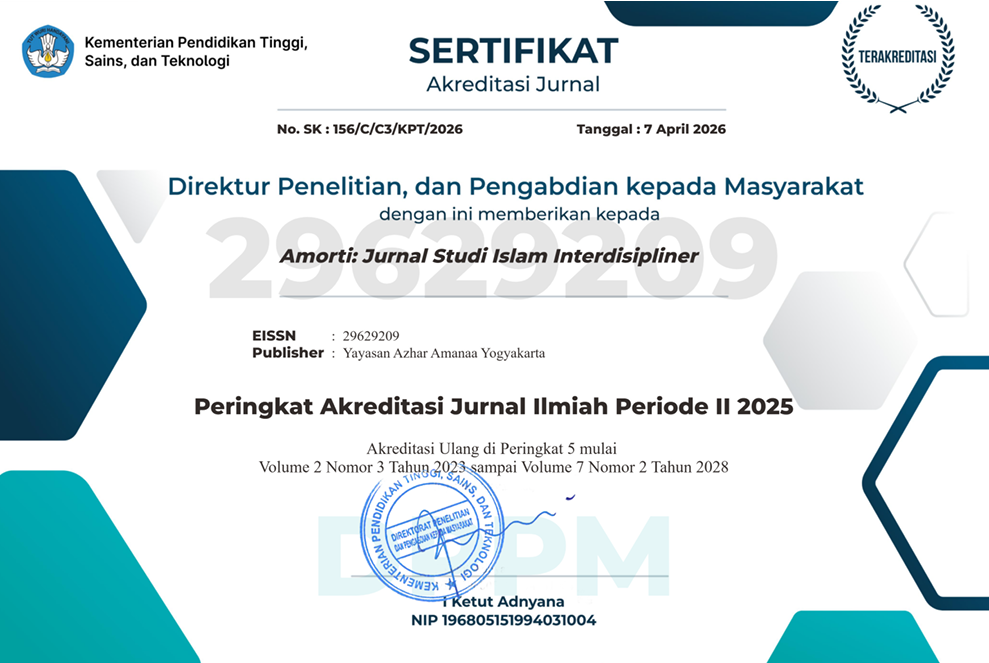
The Benefits Of The Storytelling Method On The Language Development Of 5-6 Year-Old Children At Lagan Pertiwi Paud
DOI:
https://doi.org/10.59944/amorti.v4i1.1044Keywords:
storytelling method, language development, early childhood, picture storybook, PAUD.Abstract
Language development is one of the important aspects that must be optimally stimulated in early childhood education. One learning method that can support children's language development is the storytelling method. This study aimed to analyze the benefits of storytelling methods on the language development of children aged 5–6 years at PAUD Lagan Pertiwi, Lubuk Lagan Village, Seluma Regency. This research employed a descriptive qualitative approach. Data were collected through observation, semi-structured interviews, and documentation involving the principal, teachers, and children aged 5–6 years. Data analysis was conducted using the interactive model of Miles, Huberman, and Saldaña, including data reduction, data display, and conclusion drawing. The findings revealed that storytelling methods using picture storybooks provided significant benefits in improving children's listening skills, enriching vocabulary, enhancing speaking skills, increasing the ability to express opinions, improving the ability to retell stories, and strengthening children's self-confidence in communication. The success of storytelling activities was supported by attractive picture storybooks, teachers’ storytelling skills, children's enthusiasm, school support, and a conducive learning environment. However, several obstacles were identified, including differences in children's language abilities, limited concentration spans, low self-confidence among some children, limited storybook variations, and classroom management challenges. Therefore, storytelling methods can be recommended as an effective learning strategy to optimize language development in early childhood.
References
Arikunto, S. (2021). Research procedures: A practical approach (Revised ed.). Rineka Cipta.
Dhieni, N. (2020). Language development methods. Universitas Terbuka.
Fitriyah, N., & Rahmawati, D. (2022). The effect of storytelling methods on early childhood listening skills. Journal of Early Childhood Education, 6(2), 112–120.
Hasanah, U. (2018). The implementation of storytelling methods to improve early childhood communication skills. Jurnal Obsesi: Jurnal Pendidikan Anak Usia Dini, 2(1), 45–53.
Hurlock, E. B. (2013). Child development (Vol. 1). Erlangga.
Hurlock, E. B. (2017). Developmental psychology: A life-span approach (5th ed.). Erlangga.
Isbell, R., Sobol, J., Lindauer, L., & Lowrance, A. (2004). The effects of storytelling and story reading on the oral language complexity and story comprehension of young children. Early Childhood Education Journal, 32(3), 157–163. https://doi.org/10.1023/B:ECEJ.0000048967.94189.a3
Khasanah, N., & Suryana, D. (2023). The effect of storytelling methods on early childhood language development. Jurnal Obsesi: Jurnal Pendidikan Anak Usia Dini, 7(3), 2894–2905.
Madyawati, L. (2016). Strategies for language development in children. Kencana.
Miles, M. B., Huberman, A. M., & Saldaña, J. (2018). Qualitative data analysis: A methods sourcebook (4th ed.). SAGE Publications.
Moleong, L. J. (2022). Qualitative research methodology (Revised ed.). PT Remaja Rosdakarya.
Musfiroh, T. (2017). Storytelling for early childhood. Tiara Wacana.
Nurgiyantoro, B. (2018). Children's literature: An introduction to understanding children's world. Gadjah Mada University Press.
Otto, B. (2015). Language development in early childhood education (4th ed.). Pearson Education.
Piaget, J. (1964). Development and learning. Journal of Research in Science Teaching, 2(3), 176–186.
Putri, R., & Hadziq, A. (2020). The effect of storytelling methods on receptive and expressive language skills in early childhood. Jurnal Golden Age, 4(2), 85–94.
Rahmawati, D. (2021). The effect of storytelling methods on early childhood language development. Journal of Early Childhood Education, 5(1), 34–42.
Santrock, J. W. (2018). Life-span development (17th ed.). McGraw-Hill Education.
Sugiyono. (2023). Qualitative research methods. Alfabeta.
Susanto, A. (2017). Early childhood education: Concepts and theories. Bumi Aksara.
Suyadi. (2017). Early childhood learning theories in neuroscience studies. PT Remaja Rosdakarya.
Vygotsky, L. S. (1978). Mind in society: The development of higher psychological processes. Harvard University Press.
. doi: 10.1080/19393555.2019.1657527
Rahman, R., Sakti, A. W., Widya, R. N., & Yugafiati, R. (2019). Elementary Education Literacy in the Era of Industrial Revolution 4.0. Proceedings of the Second Conference on Language, Literature, Education, and Culture (ICOLLITE 2018). doi: 10.2991/icollite-18.2019.41
Vink, R. M., van Dommelen, P., van der Pal, S. M., Eekhout, I., Pannebakker, F. D., Klein Velderman, M., Haagmans, M., Mulder, T., & Dekker, M. (2019). Self-reported adverse childhood experiences and quality of life among children in the two last grades of Dutch elementary education. Child Abuse & Neglect, 95, 104051. doi: 10.1016/j.chiabu.2019.104051