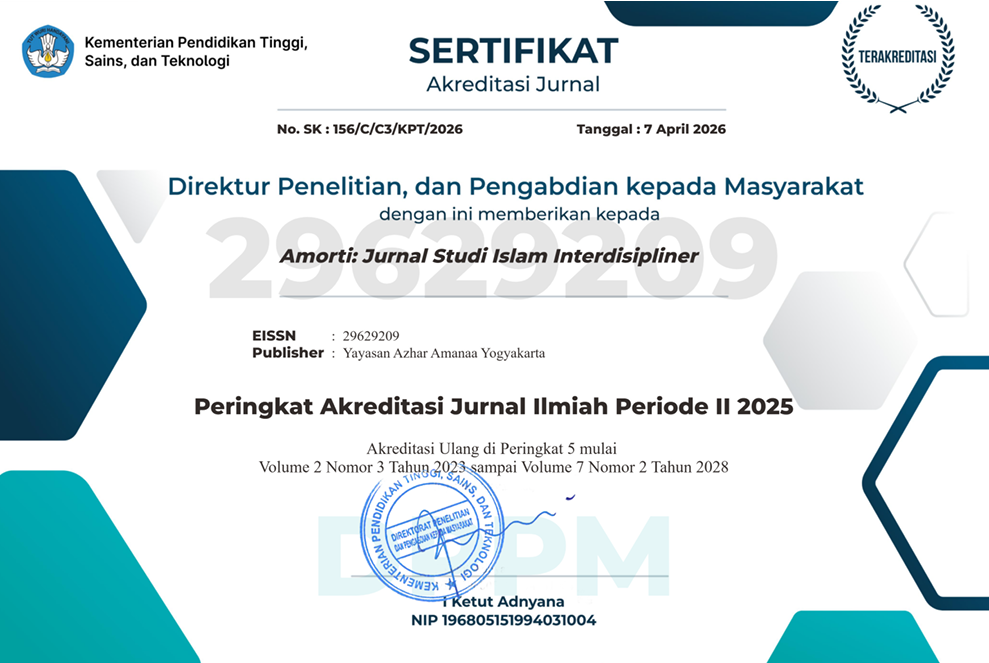
Literature Review on Deep Learning in Madrasah Ibtidaiyah: Meaningful, Mindful, and Joyful Learning Perspectives
DOI:
https://doi.org/10.59944/amorti.v5i4.1172Keywords:
Deep learning Meaningful learning Mindful learning Joyful learning Madrasah IbtidaiyahAbstract
he lack of active participation and meaningful engagement in the learning process of Madrasah Ibtidaiyah students highlights the need for a transformation toward a deeper, more contextual, and student-centered learning approach. This study aims to examine the implementation of deep learning in the context of Madrasah Ibtidaiyah education through the integration of three core approaches: meaningful learning, mindful learning, and joyful learning. This research employs a literature review method, analyzing 20 relevant national and international scholarly articles. Data were collected from digital databases such as Google Scholar, ResearchGate, and Sinta, with publications ranging from 2020 to 2025. The selected literature includes national and international journals. Thematic content analysis was used to identify conceptual patterns related to deep learning. The findings reveal that the synergy of the three approaches significantly enhances student participation, deepens conceptual understanding through real-life relevance, and fosters reflective learning awareness in a joyful atmosphere. Therefore, deep learning is considered effective in strengthening active, authentic, and meaningful learning practices at the Madrasah Ibtidaiyah level. As a recommendation, future research should test the effectiveness of the deep learning approach in classroom settings through quantitative methods or classroom action research, as well as develop appropriate evaluation instruments to support its sustainable implementation in Madrasah Ibtidaiyah.
References
Arianda, Y. D., Kamal, I., Supriadi, W., Mahdiyah, M., & Sarifah, I. (2024). Trends in Project Based Learning Models in Increase 6C Skills (Character, Citizenship, Critical Thinking, Creative, Collaborative, and Communication). Jurnal Penelitian Pendidikan, 41(2), 143–152. https://doi.org/10.15294/jpp.v41i2.18711
Astuti, M. L. (2024). The Role of 6C Skills in 21st Century Learning of Elementary School Students. Jurnal Pendidikan Sekolah Dasar Volume, 7(2), 154–161.
Azkiya, H., & Istiqomah, S. (2025). Penerapan Metode Joyful Learning dalam Meningkatkan Motivasi Belajar Siswa. Jurnal Basicedu, 9(5), 3(2), 524–532.
Feriyanto, F., & Anjariyah, D. (2024). Deep Learning Approach Through Meaningful, Mindful, and Joyful Learning: A Library Research. Electronic Journal of Education, Social Economics and Technology, 5(2), 208–212. https://doi.org/10.33122/ejeset.v5i2.321
Flook, L., Hirshberg, M. J., Gustafson, L., McGehee, C., Knoeppel, C., Tello, L. Y., Bolt,
D. M., & Davidson, R. J. (2025). Mindfulness training enhances students’ executive
functioning and social emotional skills. Applied Developmental Science, 29(2), 141–
https://doi.org/10.1080/10888691.2023.2297026
Henriksen, D., Richardson, C., & Shack, K. (2020). Mindfulness and creativity: Implications for thinking and learning. Thinking Skills and Creativity, 37(August), 1–
https://doi.org/10.1016/j.tsc.2020.100689
Huda, K., & Djono, D. (2025). Mengintegrasikan Teori Pembelajaran Bermakna dan Konstruktivisme dalam Pembelajaran Sejarah di Era Digital. Jurnal Artefak, 12(1),
https://doi.org/10.25157/ja.v12i1.18462
Kamalov, F., & Gurrib, I. (2023). A New Era of Artificial Intelligence in Education: A Multifaceted Revolution. Sustainability Article, 15(12451), 1–27. http://arxiv.org/abs/2305.18303
Khairul Faizin, A. (2023). Peran metode flipped classroom dalam meningkatkan partisipasi aktif siswa di madrasah ibtidaiyah. Jurnal Primary Edu, 1(3), 368–381. https://jurnal.rakeyansantang.ac.id/index.php/primary/article/view/103
Khawani, A., & Rahmadana, J. (2023). Penerapan Model Pembelajaran Inovatif Abad 21 pada Pembelajaran Tematik untuk Menumbuhkan Kreatifitas Peserta Didik di Sekolah Dasar. Jurnal Basicedu, 7(1), 231–240. https://doi.org/10.31004/basicedu.v7i1.4280
Kovač, V. B., Nome, D., Jensen, A. R., & Skreland, L. L. (2025). The why, what and how of deep learning: critical analysis and additional concerns. Education Inquiry, 16(2), 237–253. https://doi.org/10.1080/20004508.2023.2194502
Mashuri, A., & Yudasari, N. N. (2024). Pengaruh Mindful Learning terhadap Motivasi dan Hasil Belajar Matematika di MAN 2 Magetan. Jurnal Jendela Pendidikan, 4(04), 480–486. https://doi.org/10.57008/jjp.v4i04.1132
Mystakidis, S. (2021). Deep Meaningful Learning. Encyclopedia, 1(3), 988–997. https://doi.org/10.3390/encyclopedia1030075
Nafi, J., & Faruq, D. J. (2025). Conceptualizing Deep Learning Approach in Primary Education : Integrating Mindful , Meaningful , and Joyful. 3(2). https://doi.org/10.70376/jerp.v3i2.384
Nasir, M., & Sutiah, S. (2025). Pengintegrasian Teknologi dalam Pembelajaran di Era Digital (Sebuah Kajian Pustaka). Literasi: Jurnal Ilmu Pendidikan, 16(1), 66. https://doi.org/10.21927/literasi.2024.16(1).66-77
Nofamataro Zebua. (2025). Education Transformation : Implementation of Deep Learning
in 21st-Century Learning. Harmoni Pendidikan : Jurnal Ilmu Pendidikan, 2(2), 146–
https://doi.org/10.62383/hardik.v2i2.1405
Nopiyanti. (2025). Analisis Pembelajaran Al-Qur’an dan Hadis Berbasis Artificial Intelligence dalam Internalisasi Keterampilan Abad 21 di Madrasah Ibtidaiyah. Al-Manar : Jurnal Komunikasi Dan Pendidikan Islam, 14(6), 45–55.
Pratama, R. A., Salsabila, A., Artha, P., & Abidin, N. Z. (2024). Efektivitas mindful learning dalam konteks pendidikan di indonesia (2000-2024): Sebuah studi meta analisis. Primatika. J. Pend. Mat, 13(2), 77–92. https://doi.org/10.30872/primatika.v13i2.4483
Putri, R., Syahnam, S., Kurnia, H., Indah, M., & Fierna, M. (2024). Penerapan Deep Learning dalam Pendidikan di Indonesia. Prosiding Seminar Nasional Pendidikan Pancasila Dan Kewarganegaraan Universitas Pamulang, 2(2022), 97–102.
Ramadhan Lubis, Aulia Rahmadani, Amelia Rika Fadillah, Fadillah Fadillah, Winda Amelia Putri, Laila Khairani Nasution, & Khairunnisa Khairunnisa. (2025). Implikasi Perkembangan Kognitif Afektif Psikomotorik Moral dan Spiritual Peserta Didik dalam Pembelajaran pada Sekolah Dasar Kelas 6. ALFIHRIS : Jurnal Inspirasi Pendidikan, 3(1), 148–159. https://doi.org/10.59246/alfihris.v3i1.1187
Rianti, D., Mawardi, & Iswanto, S. (2020). Penerapan Model Pembelajaran Deep Dialog untuk Pengembangan Kemampuan Berpikir Kritis dalam Pembelajaran Sejarah Siswa Kelas XI IPS SMA Negeri 5. JIM: Jurnal Ilmiah Mahasiswa Pendidikan, 5(3), 168–178.
Wijaya, A. A., Haryati, T., & Wuryandini, E. (2025). Implementasi Pendekatan Deep Learning dalam Peningkatan Kualitas Pembelajaran di SDN 1 Wulung, Randublatung, Blora. Indonesian Research Journal on Education Web Jurnal Indonesian Research Journal on Education, 5(1), 451–457.
Winje, Ø., & Løndal, K. (2020). Bringing deep learning to the surface: A systematic mapping review of 48 years of research in primary and secondary education. Nordic Journal of Comparative and International Education, 4(2), 25–41. https://doi.org/10.7577/njcie.3798
Yasid, A. (2025). Deep Learning Based On Joyful Learning In Increasing Learning Motivation. Jalla, 1(1). https://doi.org/10.22460/semantik.vXiX.XXX
Zhao, J., & Qin, Y. (2021). Perceived Teacher Autonomy Support and Students’ Deep Learning: The Mediating Role of Self-Efficacy and the Moderating Role of Perceived Peer Support. Frontiers in Psychology, 12(June), 1–11. https://doi.org/10.3389/fpsyg.2021.652796
Zulkifli, M., & Kholisah, N. (2024). Implementasi Strategi Pembelajaran Kontekstual Di Mi. Tarbiyah Darussalam: Jurnal Ilmiah Kependidikan Dan Keagamaan, 8(01), 1. https://doi.org/10.58791/tadrs.v8i01.363